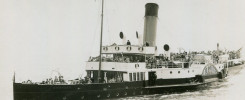
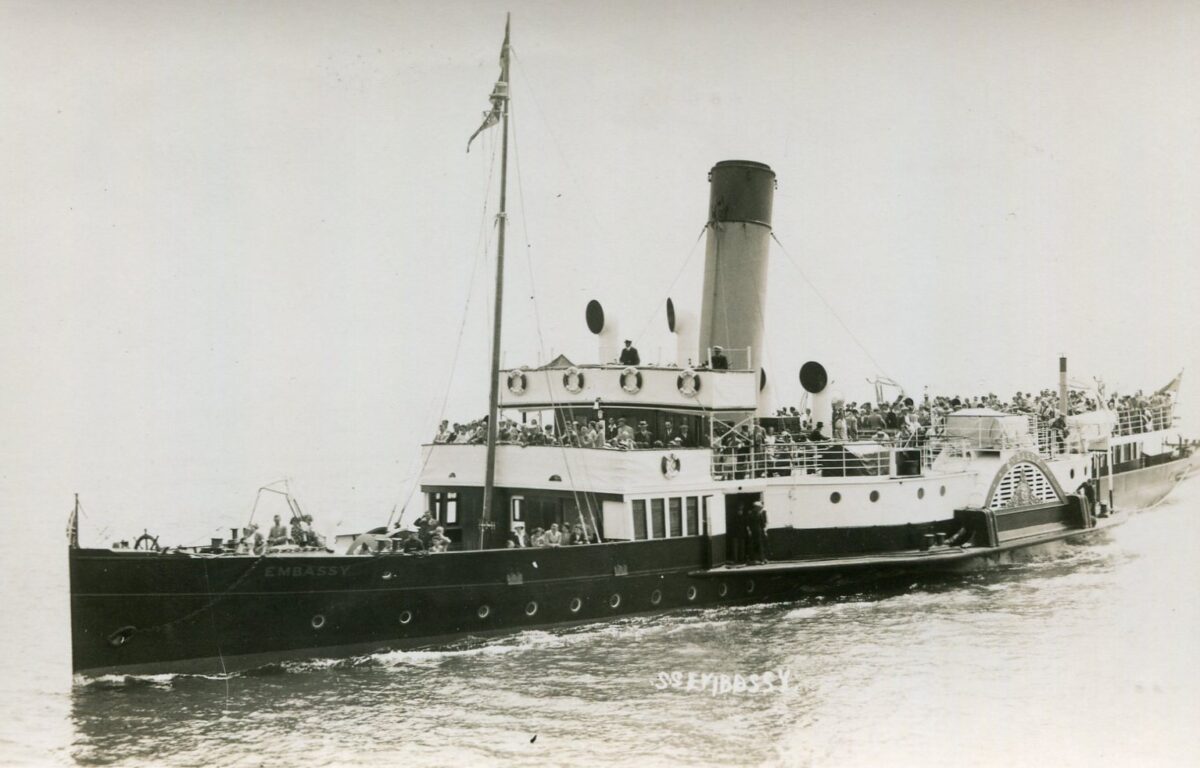
Last month we looked at how Cosens bought the Southern Railway’s 25-year-old Duchess of Norfolk in 1937 and spent a further 25% of the purchase price on structural renewals. Re-emerging as Embassy, she became the company’s principal steamer for longer-distance excursions from Weymouth. Although elderly by normal standards she was a spring chicken compared with the rest of Cosens’s ageing fleet which they kept going well beyond their design lives of 25/30 years by undertaking the necessary rebuild and renewal work on them piecemeal year on year.

Then at the end of the 1937 season the Torquay based Duke of Devonshire came on the market. As a regular visitor to Weymouth over the years she was known to Cosens. Although she was by then forty years old, she was considerably younger than their Premier, which had just celebrated her ninetieth birthday. And in need of structural work, which her then owners could not afford to finance, Duke of Devonshire was cheap. Eventually Cosens beat down the asking price even further and in the end got her for just £1,000. This scales up to £68,000 in today’s money. To put that in perspective, Cosens bought Consul for about the same price as a middle of the range Land Rover.

The deal was signed in December. She was brought to Weymouth where initially she lay alongside the elderly Premier for work start to bring her up to the standard required for the Board of Trade to renew her Passenger Certificates.
Premier left Weymouth under tow on Friday 29th April 1938 for the scrapyard at Grays in Essex.
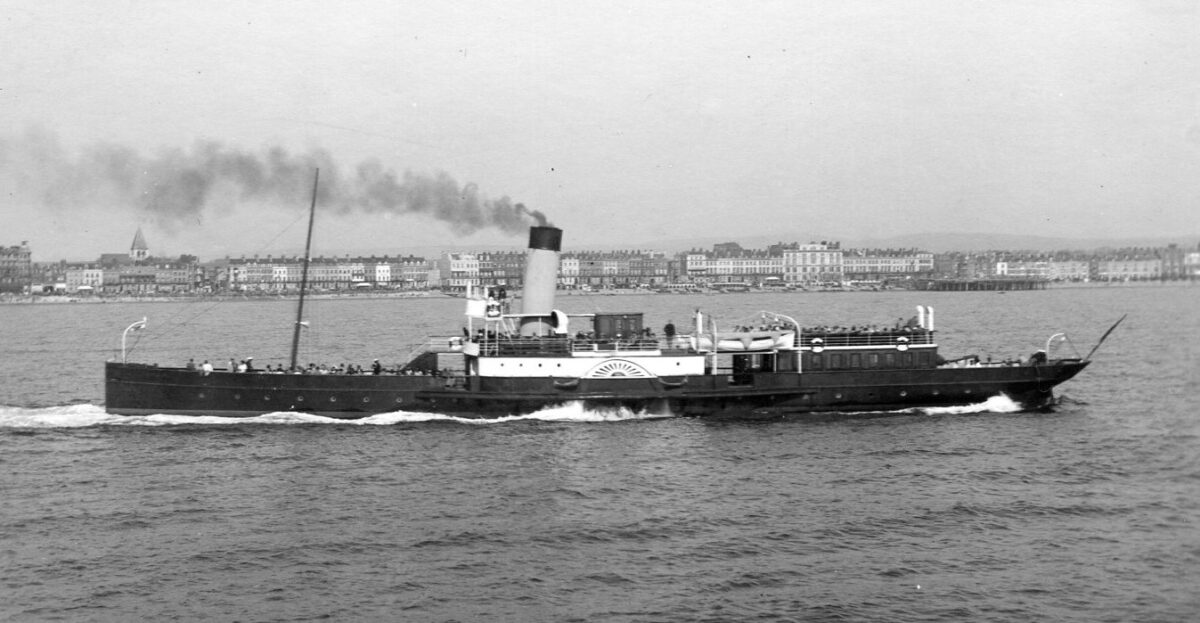
With the structural work complete, including the fitting of new inner and outer funnels, she was renamed Consul and was ready to enter service in May 1938.
She had spent her career to date putting her bow on the Devon beaches so could call at Lulworth Cove. She was bigger and better appointed than Victoria or Empress and so was more suitable for longer coastal trips. So she became second to Embassy at Weymouth sometimes running local trips and to Lulworth Cove, sometimes going to Swanage and Bournemouth from where she sometimes brought passengers back to Lulworth Cove and sometimes going even further afield according to circumstances.

Consul therefore displaced Victoria from her position in the hierarchy and she spent most of the 1938 season running to Lulworth Cove trips,
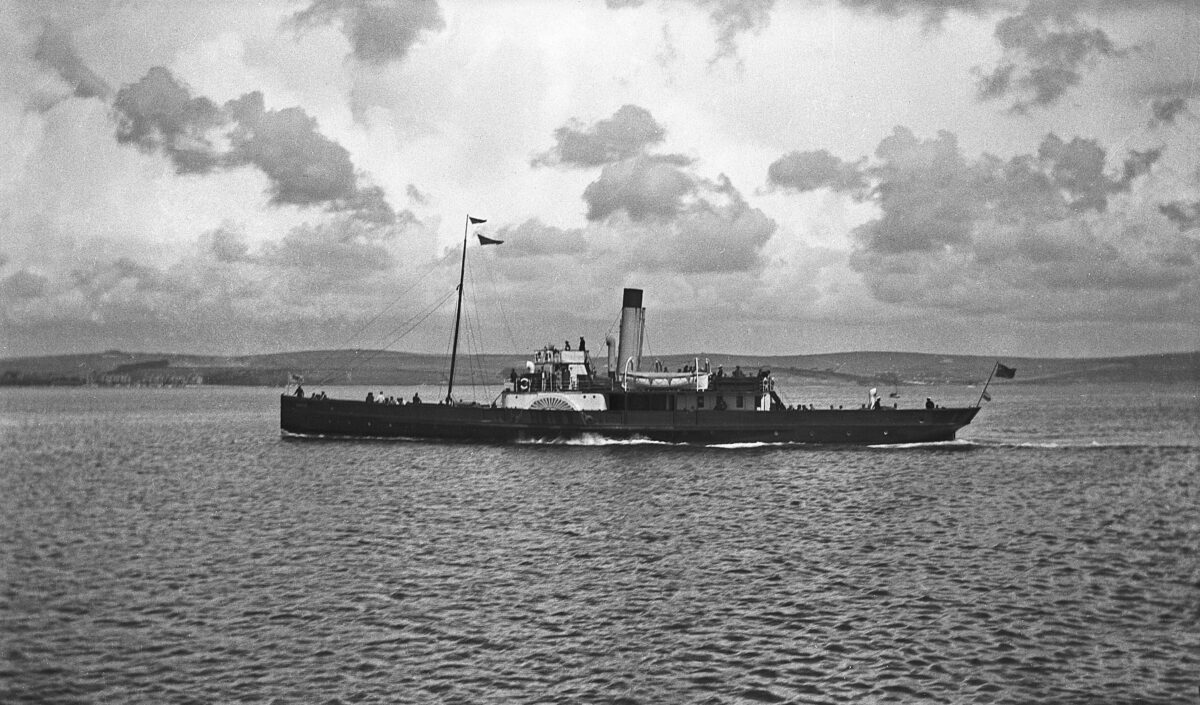
Empress inherited Premier‘s regular Portland ferry duties between Weymouth and Castletown.
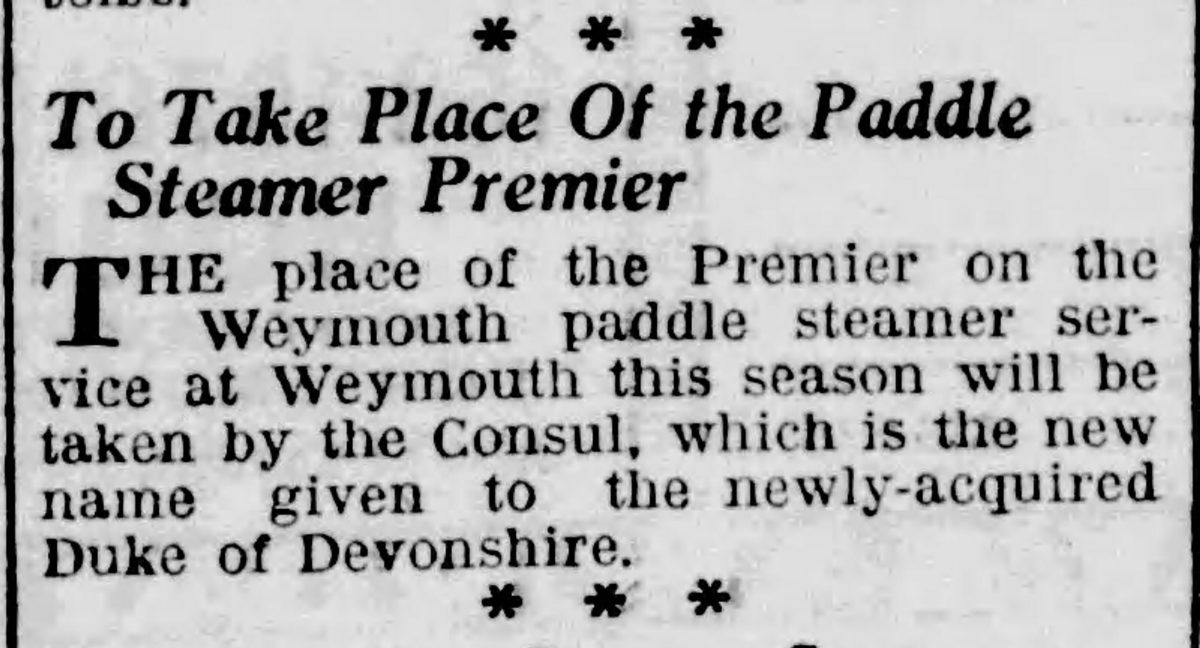
There was quite a fanfare in the press when Embassy started work for Cosens in late July 1937. By contrast Consul seems to have slipped into service quietly in 1938. The only reference I can find about her arrival in the Dorset Echo is this very brief piece one sentence piece dated 16th May.
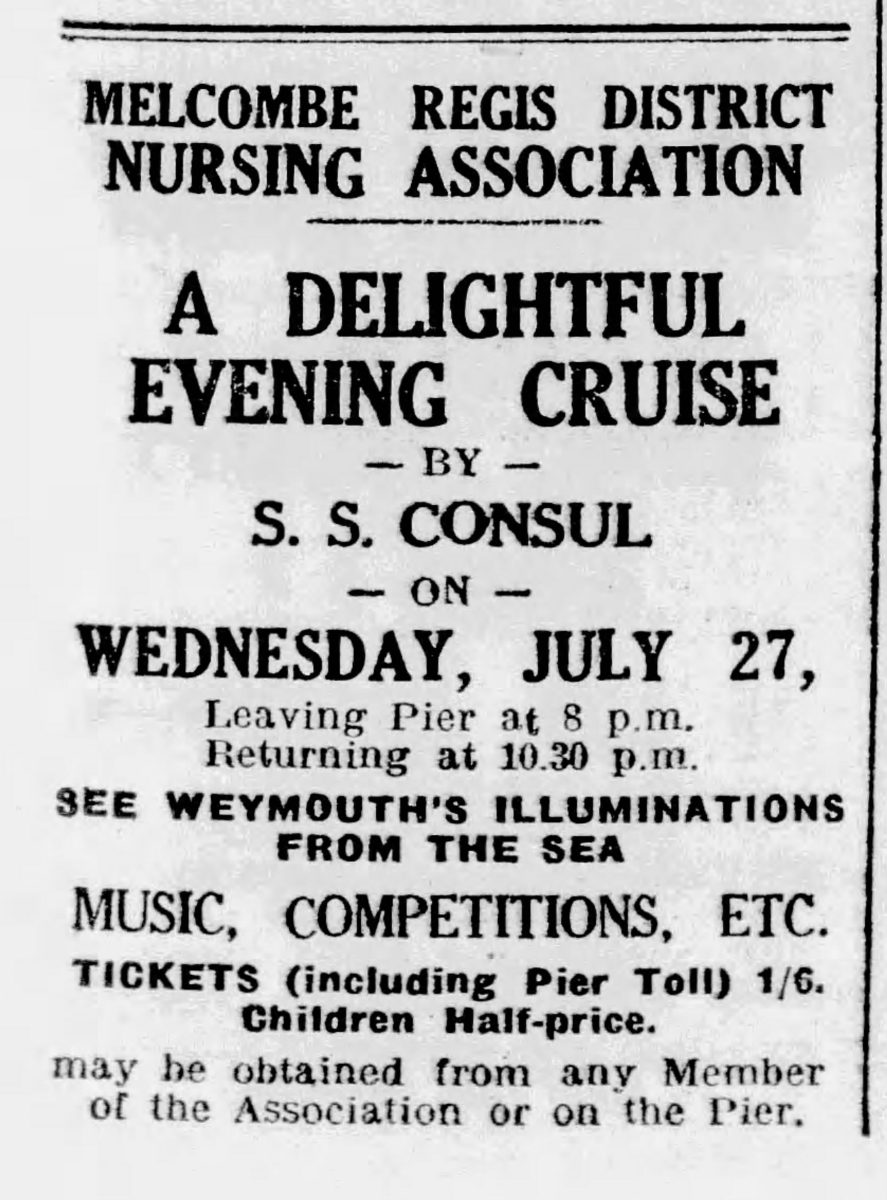
And where specific trips were advertised in the newspaper as being tun by Embassy in 1937 and 1938, Consul’s name is not usually appended to any although she was named for this evening cruise charter to Melcombe Regis District Nursing Association.
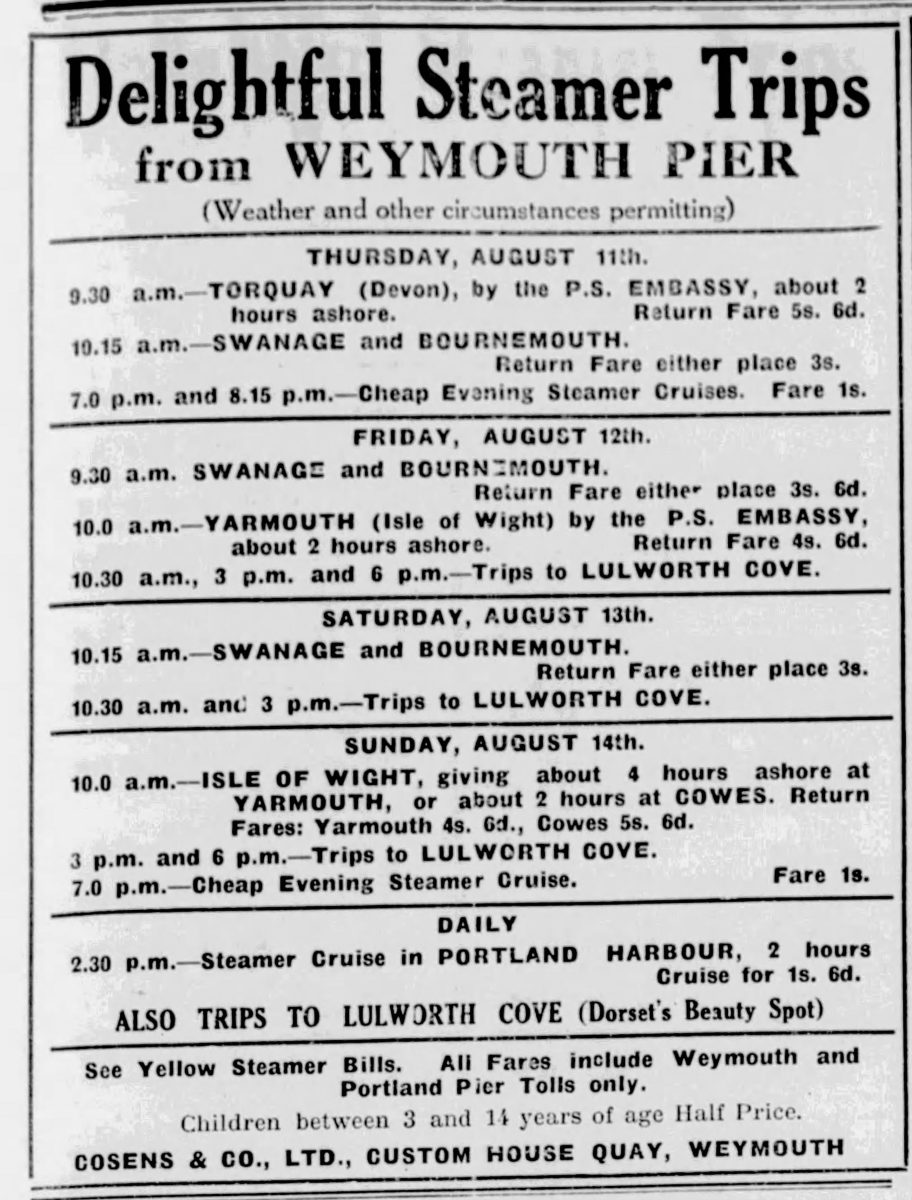
For example, in this advertisement on Thursday 11th August Embassy is billed for a 9.30am departure from Weymouth to Torquay but no ship is named for the 10.15am sailing to Swanage and Bournemouth.

This is most likely to have been taken by Consul.
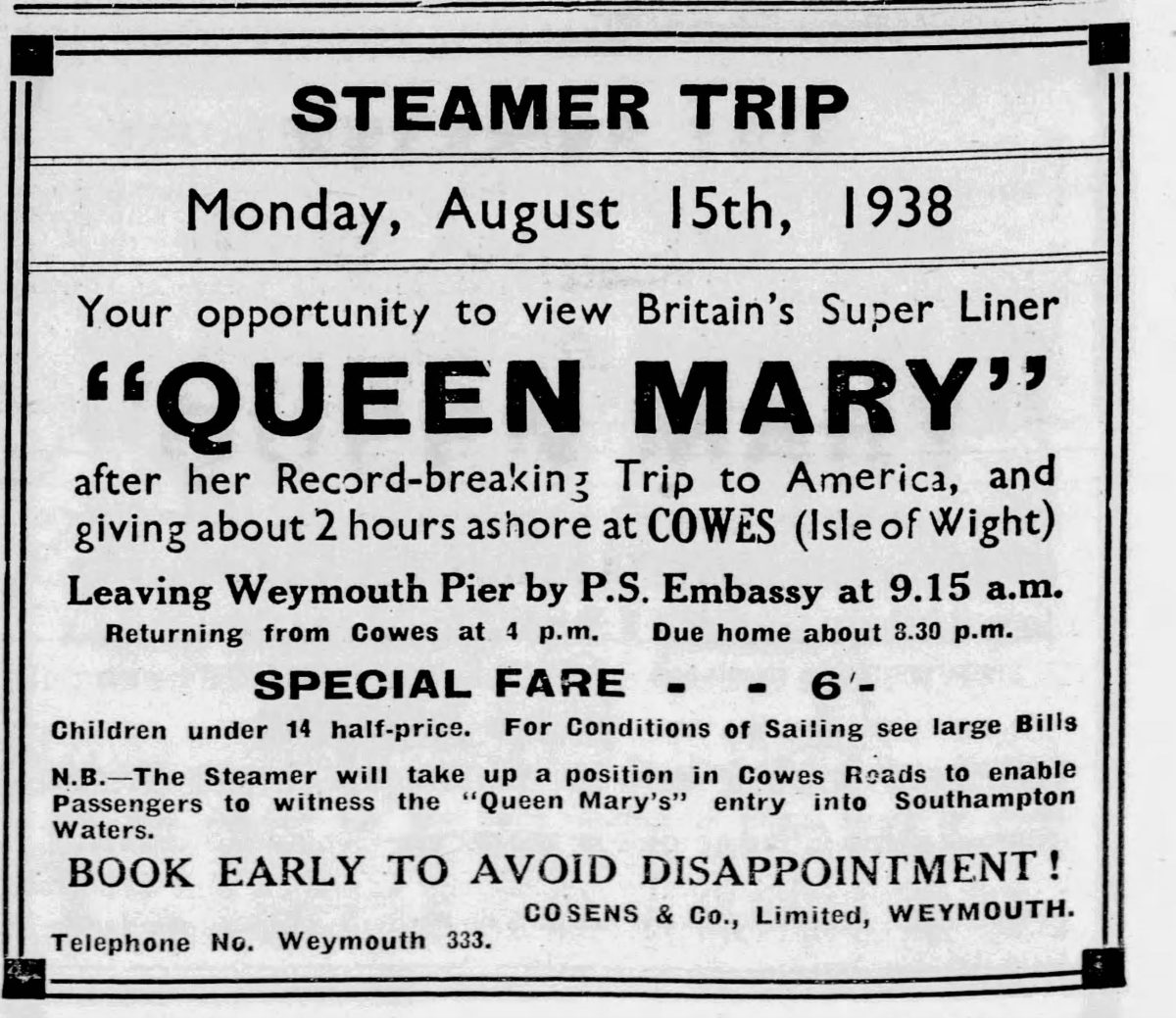
One unusual and rather special excursion for Embassy that summer took place on Monday 15 August, when she offered a trip from Weymouth to “view Britain’s Super Liner Queen Mary after her record-breaking trip to America”. The tides were particularly favourable that day. Leaving Weymouth at 9.15am, she would have had the flood tide beneath her for much of the outward journey, increasing her speed over the ground from about 12 knots to perhaps 13½-14 knots and enabling her to reach the Cowes area by around 12.30pm.
There she was advertised to “take up a position in Cowes Roads to enable passengers to witness Queen Mary’s entry into Southampton Water”. Unfortunately, by the time Embassy arrived off Cowes, Queen Mary had already docked in Southampton. Having made exceptionally good time on her Atlantic crossing, she was reported in the press as having arrived during the small hours causing some consternation as they were not ready for her with the boat trains and so on booked for the afternoon.
No account of Embassy’s day survives but it seems likely that Capt. Bowering continued up Southampton Water so that his passengers could at least obtain a good view of the vessel they had paid a premium fare and come so far to see. Such a diversion would have lengthened the day’s itinerary and may have reduced, or even eliminated, the two hours ashore advertised at Cowes. Fortunately, the tides worked in Embassy’s favour both ways Having enjoyed the flood tide on the outward journey, she would also have benefited from the ebb stream on the return, helping Embassy maintain her schedule despite the unexpected detour.
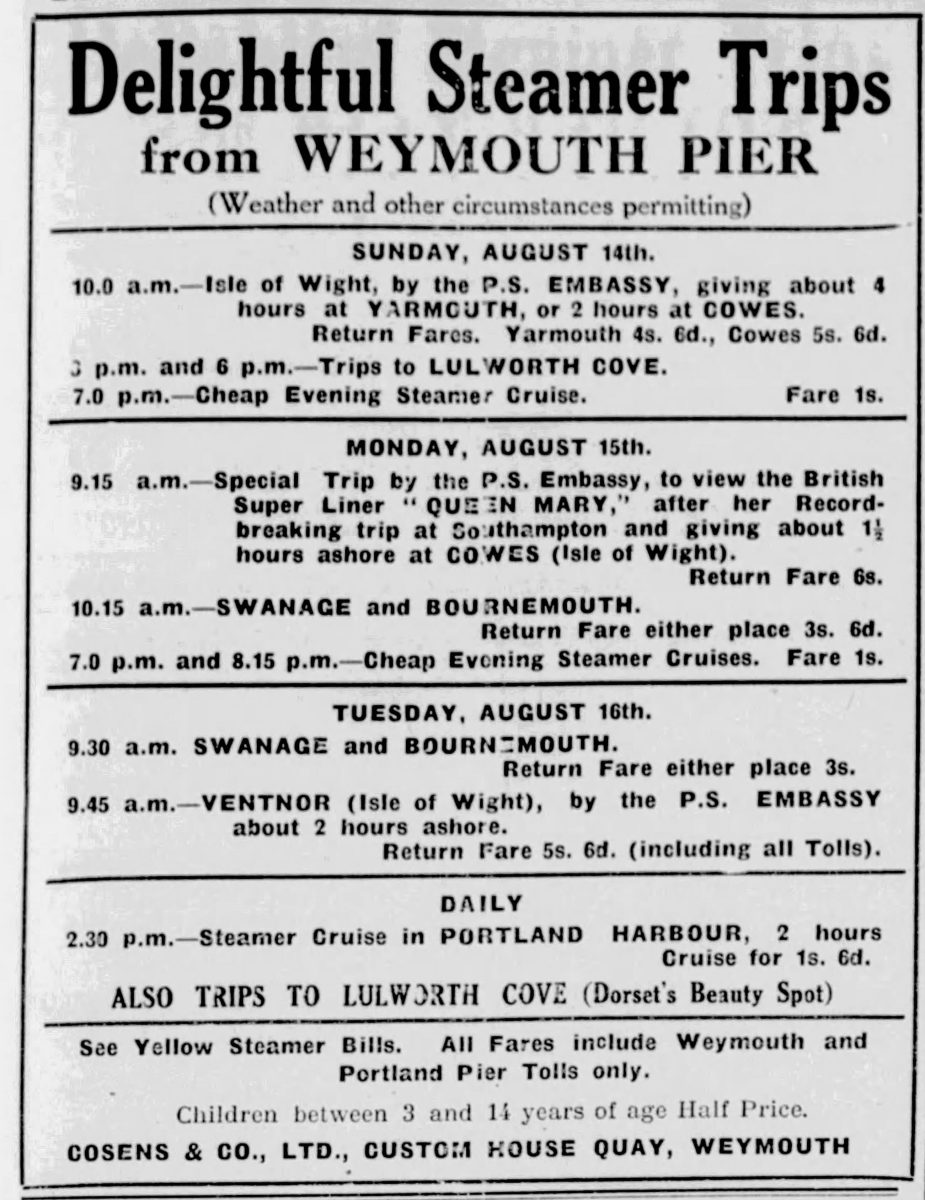
The following day, Tuesday 16 August, a trip from Weymouth at 9.30am to Swanage and Bournemouth was advertised without saying which ship was down to do it, but we know this was rostered for Consul, because her name appears in the Bournemouth steamer notice that day confirming that she was then scheduled to retrace her route, taking passengers from those resorts to Lulworth Cove.
On the same day, Embassy was due to leave Weymouth at 9.45am for Ventnor. The tides were once again favourable for the 50-mile voyage each way, assisting her on the outward journey and, having turned by the time of her return, helping her back home again. She is therefore likely to have arrived at Ventnor at around 1.45pm and, after departing at 3.45pm, would probably have been back in Weymouth by about 7.45pm.
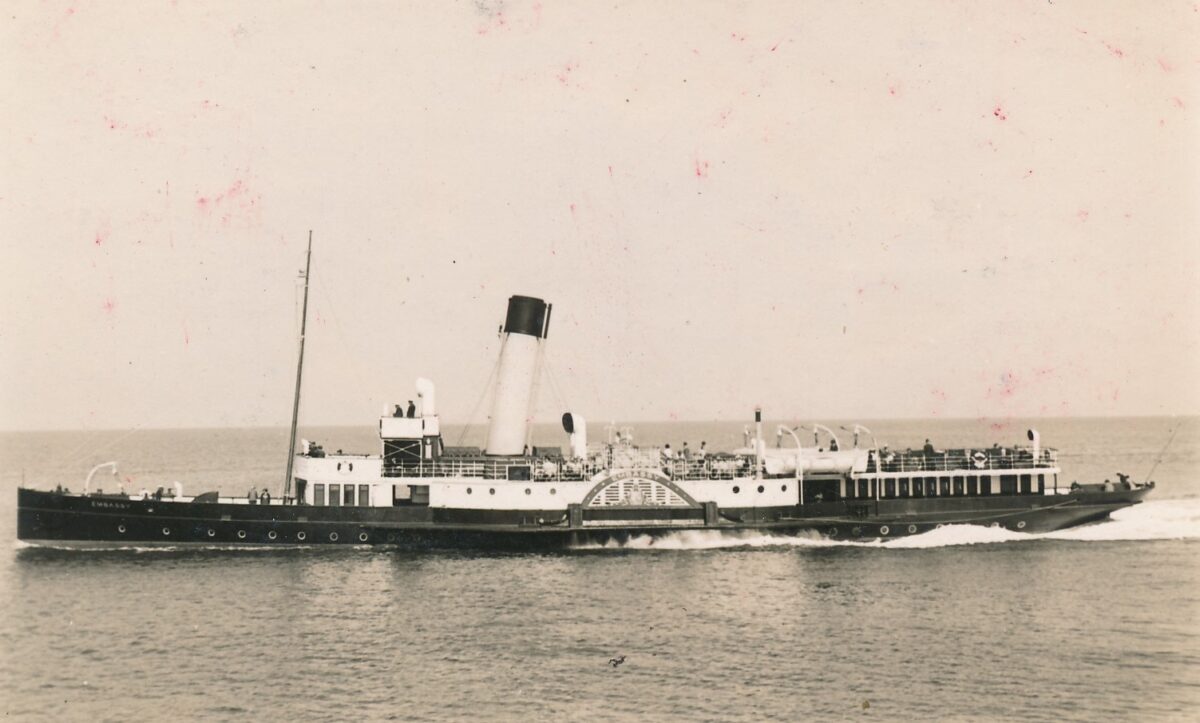
Ventnor, however, was more weather-dependent than any other Isle of Wight pier served by the paddle steamers. Projecting out into the Channel, it offered no shelter from wind anywhere from the west through south to the north-east. Weather records for August 1938 describe a heatwave across much of Europe but less settled conditions in Britain, and record that Ventnor experienced overcast skies, light rain and drizzle on that day. Whether Embassy actually succeeded in making the call and getting alongside in those conditions is not recorded.
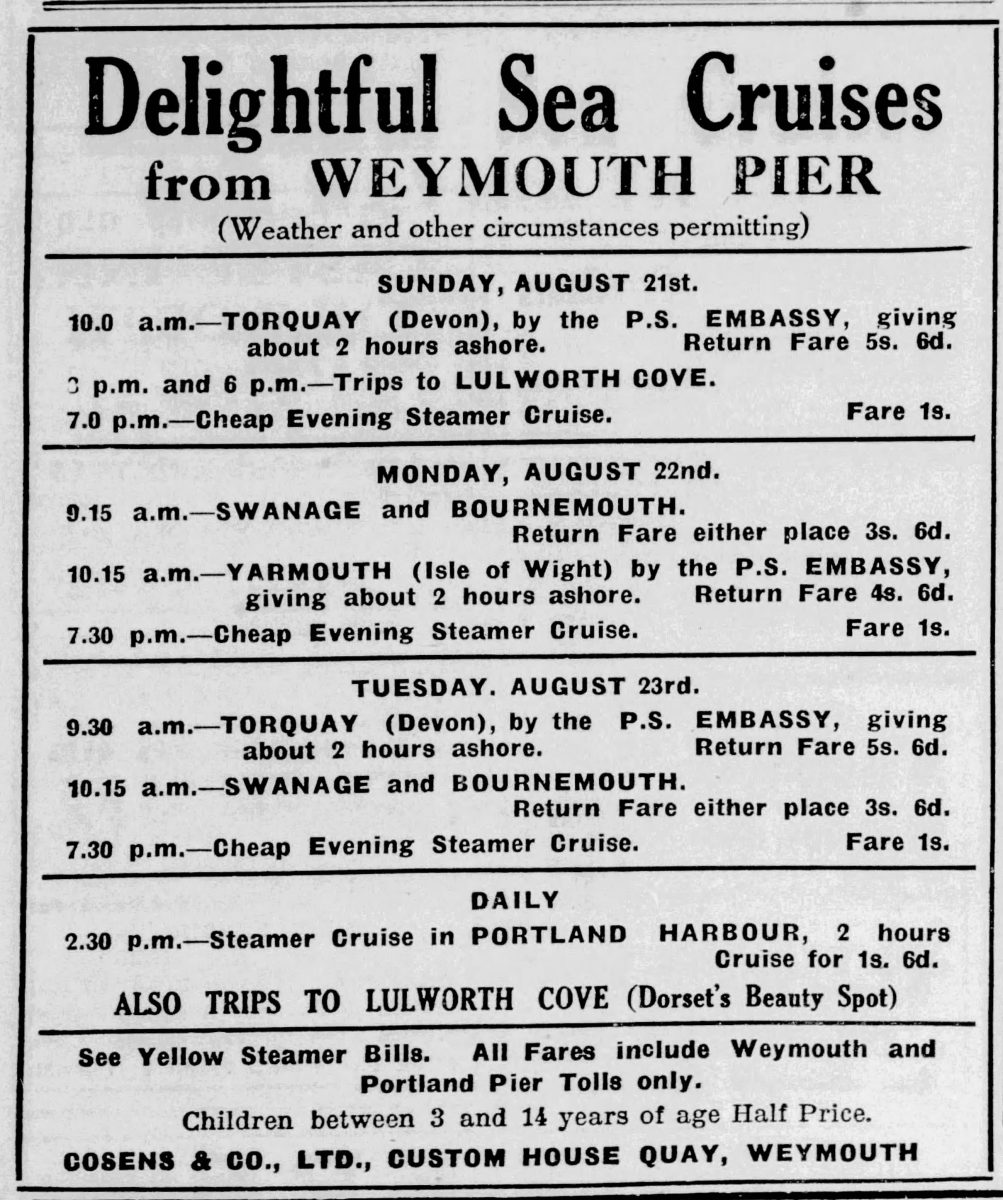
Embassy was again scheduled to sail to Torquay on Tuesday 23 August, but the records show that the day opened with thick fog. Whether or not to sail would therefore have been a difficult decision for Capt Bowering. Early morning fog frequently lifts as the day progresses, but on other occasions it can persist or even return later. A crucial factor is likely to have been the actual visibility around sailing time. If it was two or three cables (0.2-0.3 nautical miles), he may have decided to sail in the expectation that conditions would improve during the voyage. If visibility was less than one cable (about 0.1 nautical miles), it seems more likely that he would have remained alongside in Weymouth.
Paddle steamers were capable of navigating in fog by dead reckoning, using known courses and distances between recognised waypoints. Such waypoints were particularly useful when associated with an audible signal such as a bell buoy, foghorn or harbour warning signal. However, if a captain became uncertain of his position, the prudent course was to go to anchor and wait for visibility to improve.
Had visibility been around two or three cables, Capt Bowering might have chosen to sail. In that case, however, he may not have followed the usual route close to Portland’s rocky coastline and Portland Bill. Instead, he might first have headed south for the Shambles Lightship, whose foghorn provided a reliable and clear navigational mark, before turning westward to cross Lyme Bay for Torquay.
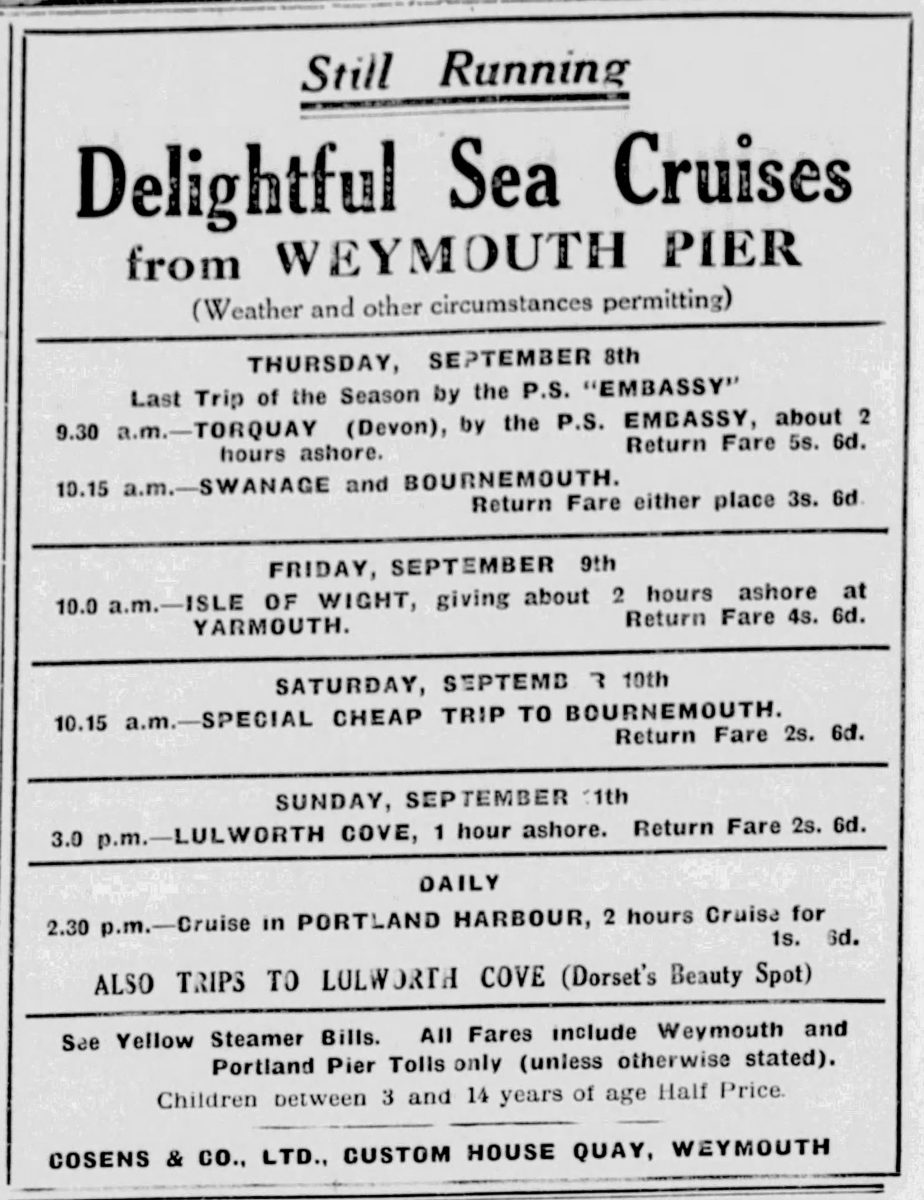
Embassy‘s last advertised trip of the 1938 season was a day excursion from Weymouth to Torquay on Thursday 8 September, departing at 9.30am. However weather records show that a deep Atlantic depression crossed the country that day, bringing gale-force winds and heavy rain. In such conditions I find it difficult to believe that the excursion actually ran. Instead, Embassy almost certainly spent the last day of her 1938 season safely tied up in Weymouth.

The following day, Friday 9 September, a trip from Weymouth to Yarmouth was advertised for 10.00 am. With Embassy having completed her season the previous day, this sailing was most likely allocated to Consul, although whether the weather had improved sufficiently after Thursday’s gale for the excursion to run is not known.
Weather has always played a part in paddle steamer excursion history, for good or ill, and the summers of 1937, 1938 and 1939 along the Dorset and Devon coasts were all very different. The summer of 1937 brought mixed and often unsettled conditions, while 1938 was generally cooler and windier. By contrast, 1939 enjoyed long periods of fine weather, culminating in a heatwave during which the highest temperature recorded in the United Kingdom reached an astonishing 35.9°C at Cheltenham.
These three years also marked a golden age for Cosens’ steamer excursions from Weymouth. Two new ships had joined the fleet, while a buoyant business model combined local trips to destinations such as Portland Harbour and Lulworth with longer sailings to Swanage and Bournemouth, together with opportunities to travel even further afield to Yarmouth, Cowes, Southampton, Ventnor and Torquay. Yet the gathering international crisis was already beginning to cast a shadow over these carefree summer voyages. Just one more season remained before the outbreak of war brought an end to these peaceful excursions along the Dorset and Devon coasts and ushered in a very different era for both Cosens and the paddle steamers they operated.
Press cuttings courtesy of the Dorset Echo. Pictures courtesy of the PSPS and JHM Collections
Kingswear Castle returned to service in 2026 after the second part of a major rebuild which is designed to set her up for the next 25 years. The Paddle Steamer Kingswear Castle Trust is now fund raising for future rebuilds. You can read more and how you can possibly help here.
John Megoran