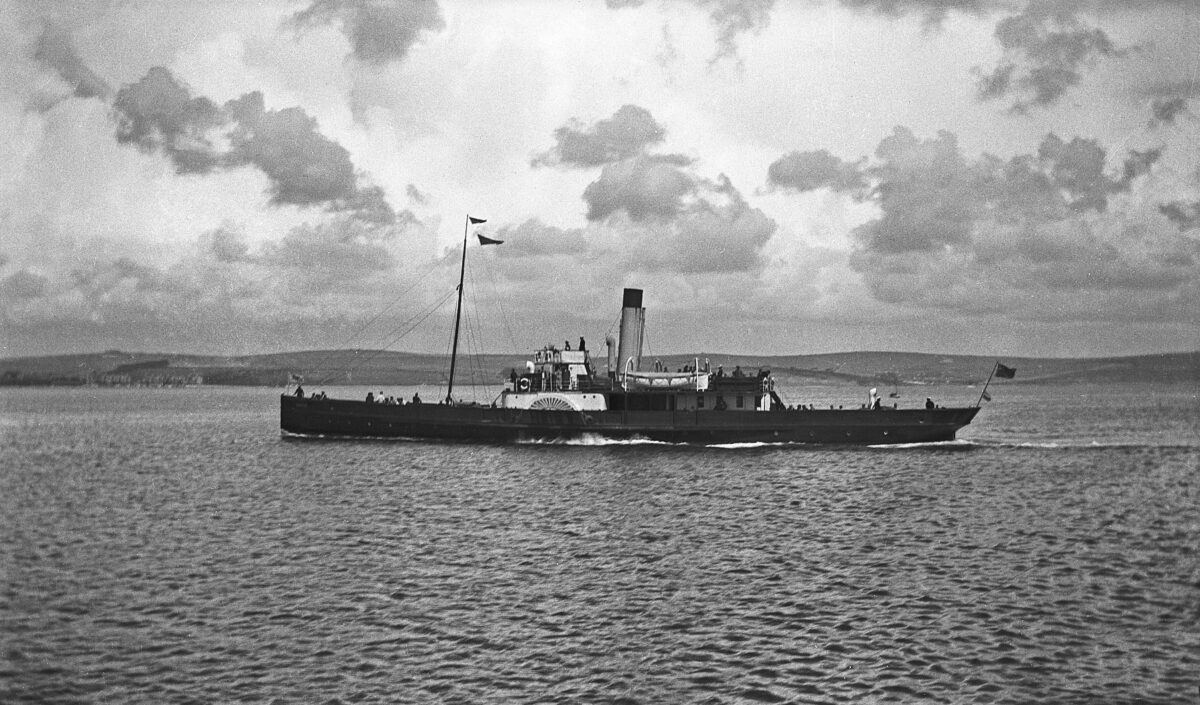
Looking through copies of the Dorset Echo from days gone by provides a fascinating insight into the ups, downs and other vagaries about Weymouth and its nautical community. The dominant players in the port were Cosens and the railway owned Channel Islands passenger and cargo ships. Everyone seems to have known everyone else. So much day to day stuff was reported in the press as well as significant events. It all reflects the huge influence of the sea and of both locally born mariners and those from elsewhere who subsequently made the town their home.
Much of what follows comes from the Dorset Echo, whose day‑to‑day reporting captured the texture of Weymouth’s maritime life better than any official record ever could. Through them, we glimpse not just careers but a community shaped by the sea.
Capt William Edward Leddy: A Life in Cosens’ Service
The funeral of retired Cosens’ Captain William Edward Leddy, late master of Empress, took place at Holy Trinity Cemetery on the afternoon of Saturday 6th May 1939.
This was attended by a huge gathering including the masters, in full uniform, of Cosens paddle steamers Capt W J S Carter of Emperor of India and commodore of the fleet, Capt P St B Rawle of Monarch, Capt R Bowering of Embassy, Capt A R Moore of Consul, Capt J Knight of Victoria and Capt E Cook of Empress. Senior and more junior staff of Cosens were well represented including Messrs Mark Frowde Managing Director, C H J Kaile, Company Secretary, J M Ward, Marine Superintendent, G F Pearce Assistant Secretary, S S T Davis, Chief Clerk and Percy Boyle Lloyds Agent.
The Echo also lists engineers, mates and other crew members from the fleet present and of course members of the family including Capt Leddy’s widow, his two daughters, his brother and sister and a vast array of friends and extended family as well.
Capt Leddy’s father had been an AB with Cosens so going afloat was in his blood. Born in 1871 he was there growing up in Weymouth as a child watching the expansion of the Cosens’ paddle steamer fleet with the arrival of the brand new Empress in 1879 when he was 8, Queen when he was 12, Victoria when he was 13 and Monarch in 1888 when he had just turned 17. He signed on as a deck boy on one of the sailing ships which visited Weymouth as soon as he could.
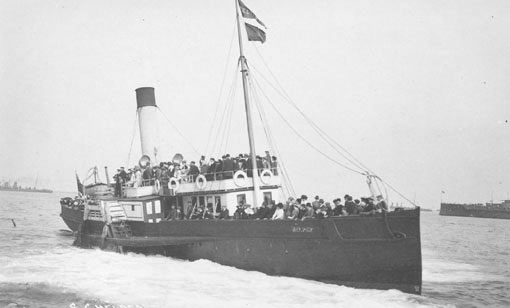
In 1898, like his father before him, he joined Cosens as an AB and gradually worked his way up to be promoted master of Helper in 1912 three years before going off to war.
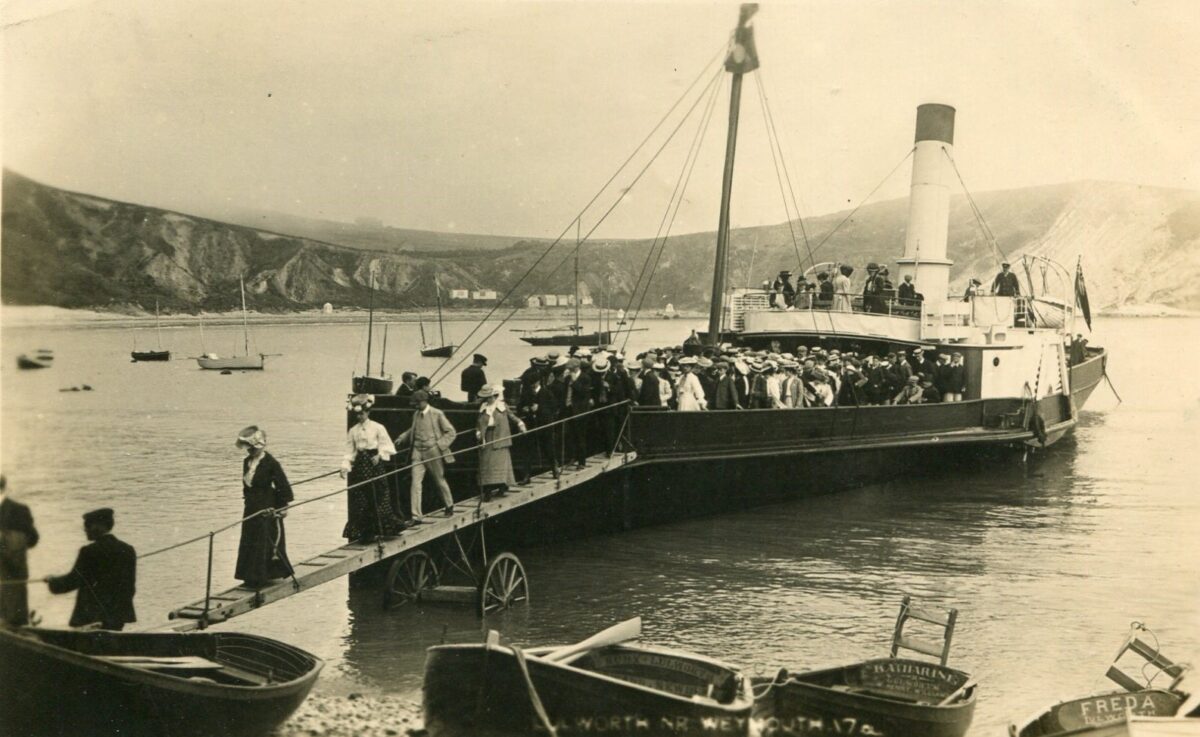
He returned to Cosens in 1927 as master of Premier and then finally moved to Empress before retiring in 1937 owing to ill heath. In a tribute at the funeral Cosens’ Managing Director Mark Frowde described Capt Leddy in his address as “A fine and fearless seaman, small of stature but big of heart, who commanded respect from all his brother officers and those who served under him.”
When a wheel box was fitted to Premier given that he was “small of stature”, Capt Leddy couldn’t see over the top of it. He therefore had a small window cut in its front. This became known as “Leddy’s peep hole”.
Five Master Mariners Meet Aboard Sambur 1953
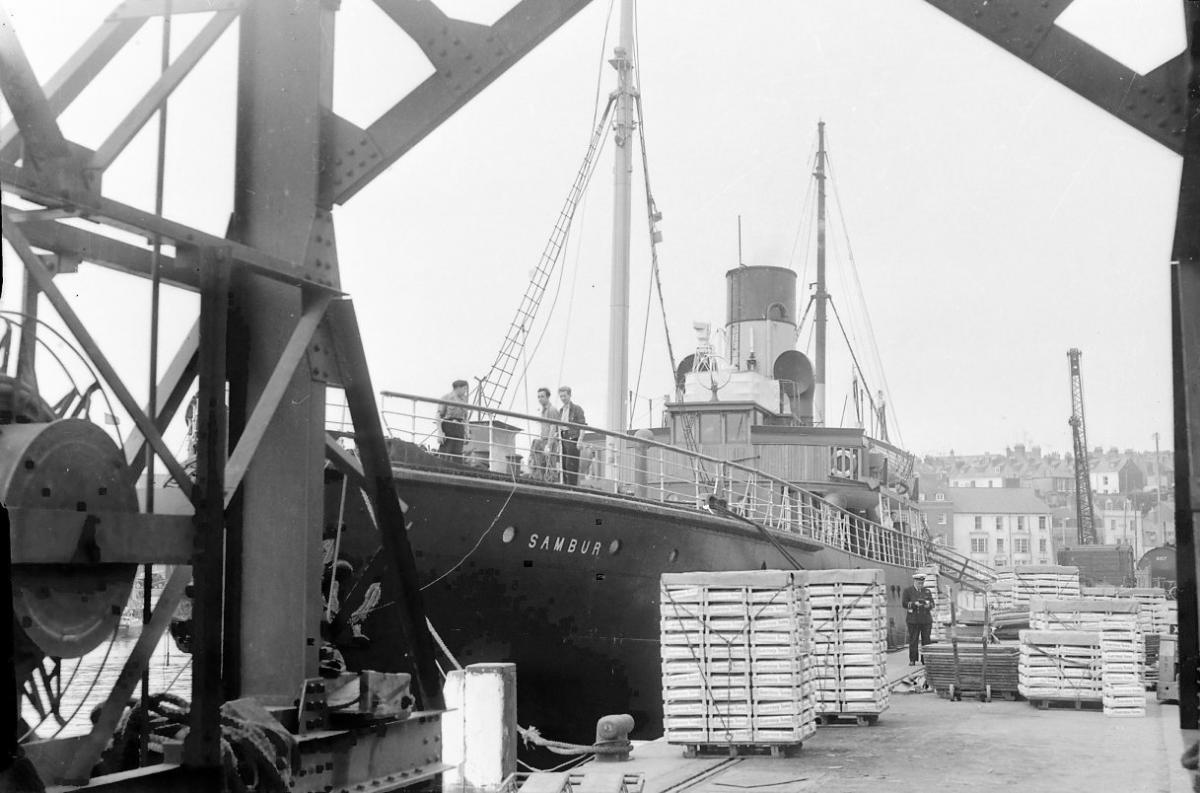
If Capt Leddy’s funeral showed the depth of Cosens’ internal community, a cocktail party of five Weymouth born master mariners on British Railways’ cargo ship Sambur, then under the command of one of their number Capt Gerry Cartwright, on 18th July 1953 revealed just how far Weymouth’s sons had travelled.
The other guests included Capt Eric Kaille of the Prince Line, Capt C Palmer of the Bank Line, Capt B Jackson of the British India Line and Capt Tom Holleyoak, then Harbourmaster at Weymouth. All had grown up in Weymouth. All had gained their first experiences of being afloat aboard Cosens’s paddle steamers as children. Capt Kaile was the son of Mr C H J Kaille who was at Capt Leddy’s funeral as Cosens’ Company Secretary and by 1953 was General Manager.
Four of these Weymouth born master mariners, three of whom were at school together, turned 50 that year. This was their first meeting for many years. Now each had command of their own ship. This was their celebration.
Capt Gerry Cartwright: From Sambur to Sarnia
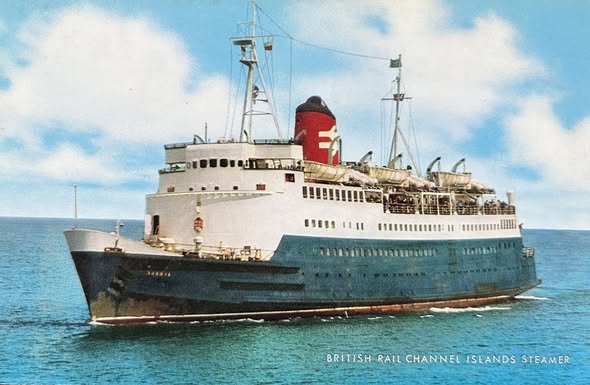
Born in 1904 Capt Cartwright joined the Great Western Railway Channel Island ships at Weymouth in the early 1930s as second mate of Sambur. After serving as chief officer on the mailboats after the ar he was promoted master of Sambur in 1952, relief master of St Julien in 1954 and permanent master of St Helier in1956. After serving as master of St Patrick in 1959 he became the first captain of Sarnia in 1961. Unfortunately whilst berthing her in St Helier in difficult weather conditions around Christmas 1966 he had a heart attack on the bridge wing. That must have been a difficult moment not only for him but also for the mate, who I believe was Bobby Rymill, and the quartermaster on the wheel. They had to take over the berthing. They had to try to do their best for the captain at the same time. He was taken to hospital and I am pleased to say made a complete recovery. He died in 1987 aged 83.
Weymouth Bay Avenue: An Enclave for Mariners
Capt Cartwright lived in Weymouth Bay Avenue, part of an estate of detached and semi-detached houses plus some bungalows off the Dorchester Road built in the 1930s for Weymouth’s expanding middle classes. This seems to have been a popular location for Weymouth mariners with one of his neighbours being Alf Pover last Chief Engineer of the Embassy.
Alf Pover: The Engineer Who Made Engines Shine
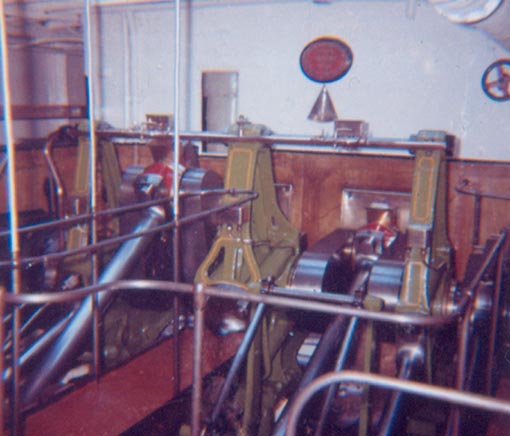
Alf was another Weymouth lad. Born in 1914 he joined Cosens from school and served as an apprentice with them for five years before signing on with the Royal Fleet Auxiliary in 1935. After the war he returned to Cosens, now with a Chief Engineer’s ticket, and sailed as Chief on Embassy, Emperor of India, Monarch and in her final years from 1961 to 1966 Embassy.
He kept an immaculate engine room. I remember my first trip on Embassy in 1960 her engine room looked a tip, dirty, greasy and quite unlike the immaculate and sparkling engine rooms I knew on Consul and Monarch. After Monarch was scrapped after the 1960 season Alf moved to Embassy, got his hands dirty and transformed her engine room into a palace. It gleamed after that just like the others.
Cosens’ paddle steamers were on the small side when compared with the railway paddlers at Portsmouth and on the Clyde. They had smaller engines and smaller engines require lesser certificates of competency to run them. Helper, Premier, Empress, Victoria and Consul all had engines under the size which required a BOT certificated engineer to operate them. Cosens could use trusted and experienced fitters from their works instead if they wanted. Embassy and Monarch were of a size which did require some certification but someone with a second engineer’s ticket could sail as chief on them. And as the paddlers sailed only in a defined area the BOT could, and on occasion did, approve senior fitters recommended by Cosens to sail as Chiefs on them too. Only the much larger Emperor of India required a fully certificated chief. That is why Alf was so useful to them. That is why he sailed as chief on Emperor.
After Embassy was sold for scrap Alf was retained by Cosens as General Foreman and supervised refit work undertaken by the company including on the Channel Island Mailboats and cargo ships. He became Works Manager in 1975 and retired in 1979. He died in a house fire, caused by the overheating of an electric blanket, at his home in Weymouth Bay Avenue in November 2004 aged 90.
Eric Plater: The Mate Who Might have Been Master
Another resident of Weymouth Bay Avenue and neighbour of Capt Cartwright and Alf Pover was Eric Plater last chief officer of Embassy.
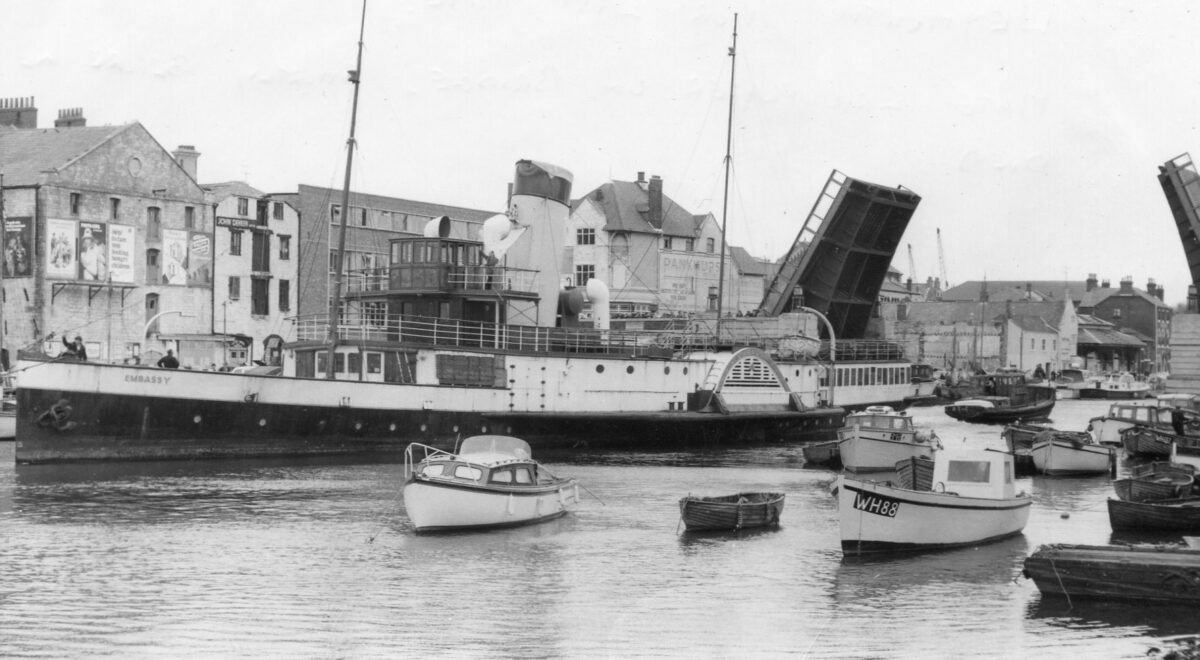
The Echo reveals an unexpected pre war chapter in Eric’s life in a news item on Wednesday 8th May 1946 concerning a “Reinstatement Decision in London”. Before the war Eric had been supervisor for Bladen Dairies. They had been taken over by Lovells Creameries who were serving the same customer base so now he wanted his old job back. Lovells didn’t want him as they had their own supervisor but had offered him a job as a roundsman instead. Described in the Echo as “recently invalided out of the Navy as a Lieut Cdr”, Eric didn’t want to be a roundsman so he took his case to a Weymouth based tribunal which ruled in his favour. Lovells appealed and the London based umpire overruled the previous Weymouth based decision. So Eric did not return to the world of milk.
Instead he noticed an advertisement for Cosens who were looking for mates for their excursion paddle steamers. Victor Gray told me that Eric revealed to him that he was captain of P & A Campbells’ Glen Usk when she was a minesweeper during the war returning her to her civilian owners in Bristol before leaving the Navy. So he had already been a wartime paddle steamer captain and was a Lieut Cdr in the RNR when he applied to, and was taken on by, Cosens as a chief officer.
In those days naval officers who had served in the rank of Lieut Cdr were permitted to sail as mate on domestic passenger vessels without needing a BOT Home Trade Mate’s ticket. In today’s world of STCW certification that couldn’t happen. But back then it was allowed. However this dispensation did not extend to enabling them to sail as master even if they had commanded a ship in the war. For that they needed the BOT Home Trade Master’s ticket as a minimum.
I remember Capt Defrates telling me that Eric was thinking of taking his master’s ticket sometime in the 1950s. Capt Defrates lent him some books and offered help and advice. But Cosens wouldn’t give him paid leave to take the exams or pay the cost of taking them. Eric was pressed for cash, Cosens not being great payers. He had a wife and son to support so he never did take the exam.
If he had things might have panned out in a different way. He was senior mate in the Cosens’ pecking order to John Iliffe, who only joined the company in 1959. If Eric had obtained his Master Home Trade ticket it is likely that he, rather than John who did have a Master’s ticket , would have been given command of Consul in 1960, when Capt Rawle retired, and Embassy in 1962 when Capt Haines became a Poole Pilot. Eric might therefore very well have ended up as Embassy’s last master with John Iliffe as his mate rather than the other way around. How fickle life can be sometimes.
I wonder how the much more experienced Eric, who had been captain of a much bigger paddle steamer in the war, felt about sailing as mate on Embassy with a master new to the company who had no previous paddle steamer handling experience. That must have been hard, mustn’t it?
However, whatever his private thoughts, I believe that Eric was very generous with his advice. I remember Capt Iliffe telling me years later that “Eric was a great help to me.”
Eric was a very good mate. Emperor of India and Embassy were always immaculately turned out on his watch. The decks were well scrubbed. The varnish gleamed. The crew seemed to be happy in their work. I remember his catchphrase when clicking his passengers on and off to keep Embassy running to time: “Hurry along at the gangway please.”
Eric’s wife Doris died in December 1965 aged just 50. Cosens’ last paddle steamer Embassy was withdrawn nine months later after the end of the 1966 season. So a lot at the core of Eric’s life and loves was changing around that time and not for the better.
Cosens kept him on as foreman at the yard after the withdrawal of Embassy to organise the men for work on other ships they were refitting including the Channel Islands mailboats but sadly he had a heart attack and died, aged just 56, during the summer of 1967 only a couple of months after taking Embassy from her berth in the Backwater through the Town Bridge to await the tug which would tow her to the scrapyard in Belgium.
A Cousin, a Hairdresser and the Road to Cosens

As another example of what a small world it was, Eric Plater was a cousin of Harry Defrates. He too had been in the Navy in the war after which he set up in business with his wife as a hairdresser called Maison Francis (Francis was his middle name) in Seaview on the Isle of Wight. That didn’t work out. Cosens were still recruiting. Eric advised him of this. Harry had a foreign going master’s ticket. He applied and so he came to Weymouth.
I remember him telling me that in his first season as mate of the twin funnelled Monarch he was still living on the Isle of Wight so didn’t get home very much that summer and had to stay aboard which he didn’t much like as the accommodation on Monarch was pretty basic. Sometimes if he had a Saturday off to go home he was picked up on a Sunday by the first Cosens steamer to call at Yarmouth to start his working week back on Monarch.
Harry gained his first command as relief master of Embassy in July 1948 and became permanent master of Victoria in 1952. He subsequently commanded Consul and the second Monarch when Alf Pover was her chief. The two made a formidable ship handling team with Harry on the telegraph on the bridge and Alf pulling the levers in the engine room below. After leaving Cosens he was master of Princess Elizabeth at Torquay in 1961, Bournemouth 1962 and Weymouth 1964. He was Consul’s captain on the Sussex Coast (where his father had been a paddle steamer captain in the 1890s) and Thames in 1963. He was Consul’s last master taking her on her final voyage under her own steam from Weymouth to Dartmouth in February 1965.
And now for some fragments from the Dorset Echo which give added background flavour:
Tiny Point of Detail 1: Flags and Civic Pride
Eric Plater wrote a letter to the Echo which they published on Saturday 22nd November 1947. It said “Why no flags at Weymouth on the day of the Royal wedding? Apparently we must have the American fleet here before the Corporation allow the town to be decorated. Or was it really too wet? Flags or no flags good luck to E and P. Signed Eric S Plater, Lieut Cdr RNR 11, Weymouth Bay Avenue, Weymouth.” The editor responded “Flags were flown from public buildings in Weymouth on Thursday. The flag staffs on the Esplanade were removed at the end of the summer season.”
In further continuation of this discussion a Mr G Harrison wrote to the Echo on Wednesday 26th November from the Grosvenor Hotel saying: “May I, as a stranger to this town and having been here on the day of the Royal wedding, be allowed to congratulate and heartily endorse Lieut Cdr E Plater’s well worded remarks concerning the lack of flags and similar decorations in the town on Thursday, surely a day of great importance to the people of Weymouth. Even though the flag staffs have been removed from the Esplanade surely a greater effort could have been made to decorate this naval town on 20th November 1947.”
Tiny Point of Detail 2: The Kaile Dynasty
Charles Kaile spent his life with Cosens starting out as a clerk in 1902, retiring as General Manager in 1958 and then serving as Chairman of the Company. He did so much else around the town too. He was on the Council. He was on and chaired all manner of committees. He was Mayor. And for relaxation he was Chairman of Weymouth Operatic Society.
He was also a friend of my grandma, who was also on the Council and a one time mayor of Weymouth. Through that connection I was given the house flag and name pennant from Monarch when she was withdrawn. This pleased my nine year old self no end. I put a flag pole up in our garden from which to fly them. Sometimes I used to haul them up in later years on KC. I still have them here at home with me sixty six years later as treasured possessions. They still have the faint smell of smoke from Monarch’s coal-fired boiler about them.
Charles Kaile died in September 1964 aged 81. His son, Capt Eric Kaile, started out as a boy in Weymouth observing and sailing on his father’s paddle steamers. He went on to command ships in the Prince Line before retiring to his home town. He died seven years after his dad in March 1971 aged 68.
Tiny Point of Detail 3: Darker Corners of theTrade
Pilfering of the odd tomato or potato from the Channel Islands’ cargoes falling out of a basket in the hold was sort of accepted and tolerated up to a point. It was hard to stop and prove if the scale was light. But pilfering on a grander scale, and particularly of other goods which were more traceable from point of origin to point of delivery, was taken far more seriously. I remember the Caesarea being raided by what was called “The Flying Squad” on one occasion in 1966. They went through all the crew accommodation looking for evidence.
Two years before Capt Cartwright’s cocktail party, five seamen from Sambur were remanded in custody in Guernsey on Tuesday 24th July 1951 charged with stealing twenty five pairs of shoes from the hold of the vessel whilst alongside at St Peter Port. Sambur’s then master Capt Goodchild, who lived at 5 Cove Row Weymouth, telephoned his office in Weymouth seeking instructions as he was now five crew short and was due to sail that night with thousands of baskets of perishable tomatoes already loaded.
Replacement crew were dispatched and Sambur sailed on schedule. At their trial Advocate Randall argued that the accused should be treated as first offenders and bound over. Mr Casey for the prosecution said “People cannot trust the transport to which the goods are entrusted if men like the accused are going to plunder cargoes.” The five, including Sambur’s quartermaster, were gaoled for three months “with hard labour”.
Tiny Point of Detail 4: Capt Leddy, Electricity and Modernity
According to the Dorset Echo, when he died in May 1939, Capt Leddy was living at 62 Lanehouse Rocks Road. This was part of quite a large residential estate mostly of bungalows built from around 1933 on the outskirts of Weymouth with the primary intention of being sold for owner occupancy. There is a series of ads in the Echo in 1933 for electricians to wire them. This is revealing.
Remember it was Cosens who brought electricity to Weymouth in the 1880s. They did work on RN ships. They were starting to be fitted with electricity in the 1880s so Cosens had to learn about this new fangled power source. As a result they set up their own DC generating station in Weymouth, which served a few residents and businesses, almost twenty years before the Borough got its own DC electrical supply. It was not until the 1920s that towns and cities started to use AC but even then with no commonality of voltage. It was not until 1933/35 that the National Grid was set up to deliver AC at a universal voltage across the country. This created a huge demand for men to be trained to implement this new development and take electricity into people’s homes on an extensive scale. This was just when Capt Leddy’s new bungalow was being built so finding competent electricians in this expanding market may have been easier said than done. Hence the need for ads in the Echo.
And Finally:
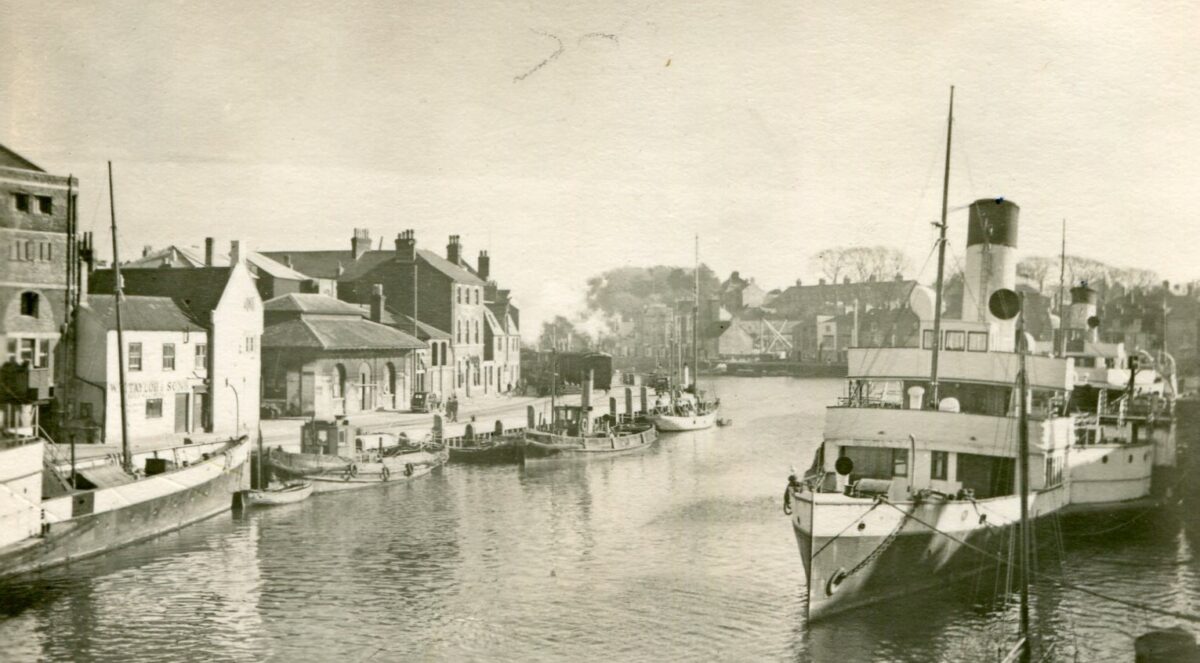
Taken together, these stories remind us how deeply Weymouth’s maritime life depended on continuity both from those who grew up in the town and those who subsequently made it their home. Boys who watched Cosens’ paddle steamers would one day become the men who commanded ships across the world, ran their engine rooms, repaired them and eventually passed their knowledge on to the next generation. Their careers ranged far beyond the Weymouth harbour walls, yet they remained rooted in the same streets, the same houses and the same shared memories. Cosens said in their pre WW1 steamer guidebook that they sent their apprentices all around the world. And in that they were stating no more than the absolute truth.
Kingswear Castle returned to service in 2026 after the second part of a major rebuild which is designed to set her up for the next 25 years. The Paddle Steamer Kingswear Castle Trust is now fund raising for future rebuilds. You can read more and how you can possibly help here.
John Megoran