
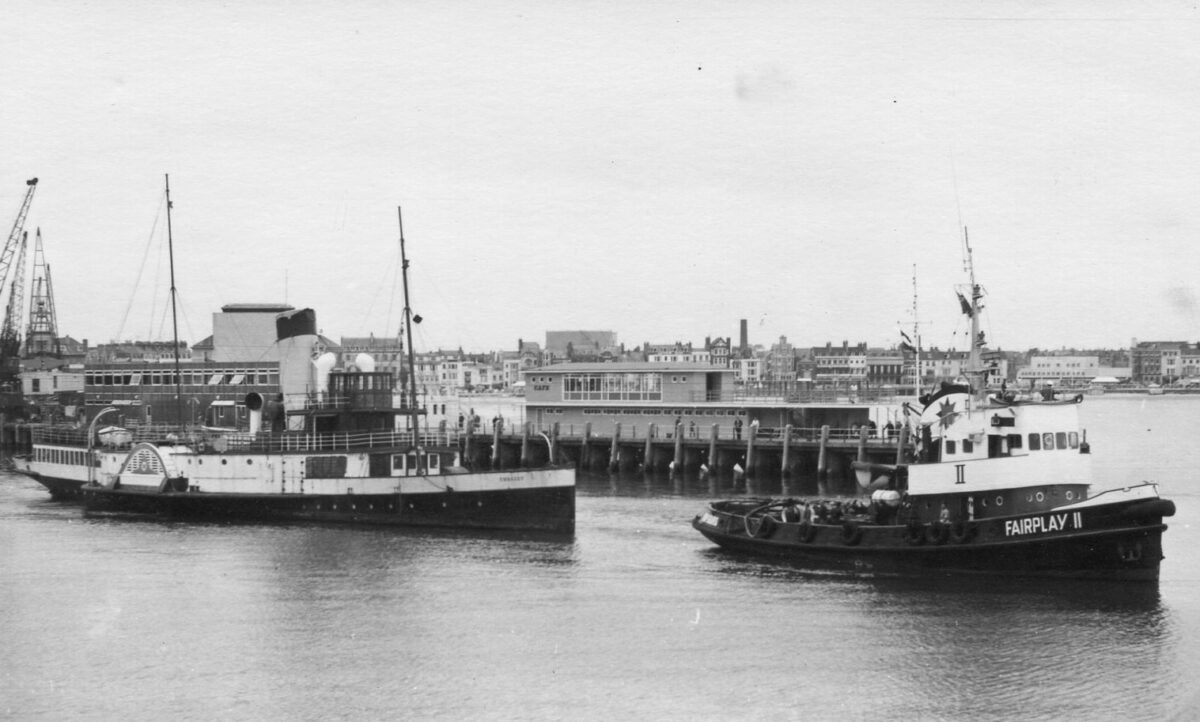
Sunday 13th September 1959 was Captain Phillip St Barbe Rawle’s last Sunday in command of a paddle steamer retiring as master of Embassy the following Friday according to the Bournemouth Echo.

Captain Rawle had been around Cosens’ paddle steamers all his life. His father had been a master with the company, and Phillip grew up in and around the ships. Promoted young, he went on to notch up thirty‑four years in command of Cosens’ steamers, plying the South Coast in an area bounded by Torquay and Dartmouth in the west and to the Isle of Wight in the east. His knowledge of the area was encyclopaedic; his ship‑handling in all conditions second nature. He was also a fund of advice for newer captains as they were promoted over the decades.

Born in February 1894, Capt Rawle was 65 in 1959. He could have gone on to 70, as some paddle steamer captains did – after which Trinity House took away their Pilotage Certificates – but he retired at 65. Whether that was his choice or dictated by other circumstances I don’t know. But whatever the reason puzzlingly he retired from Embassy a week or so before she was scheduled to finish her 1959 season.
Why did he do that? After a lifetime on paddle steamers, stepping off a few days early feels oddly abrupt. I have heard it said that he may not have been well, which is certainly possible, although he was clearly not so unwell that he could not continue in command until the end of that week and attend a presentation in Poole. And if he was unwell, it was not terminal: he lived on for another thirteen years until 1972.
This was also the period when his Chief Officer, Eric Plater — who had served with him on Emperor of India as well as Embassy — might have been seen as a natural successor. Plater had commanded the P & A Campbell paddle steamer Glen Gower during the war, and as a retired naval Lieutenant Commander he was entitled to sail as mate on a home‑trade passenger vessel. But not as master. For that he needed at least the Home Trade Master’s ticket. He asked Cosens for paid leave and assistance to take it but was refused. Perhaps there were background tensions around that. Was Rawle’s departure connected to Plater’s stalled promotion?
Then there is the question of Captain Rawle’s pension. It was not uncommon for long-serving officers in small companies to retire without any pension from their work. He would of course have qualified for the Government’s State Pension, which wasn’t then — and isn’t now — very much. The Merchant Navy Officers’ Pension Fund was founded only in 1938, when Rawle was already in his forties, and not all companies signed up to it. Many smaller firms, like Cosens, felt the costs too high. It is therefore unlikely he was in that scheme.
As a very long‑serving senior employee, he would have known that Cosens had occasionally granted modest pensions to a handful of key workers who had given long and loyal service. Did he ask Cosens for such a pension and was refused? I don’t know. But the Cosens minute books in the Dorset County Archive contain occasional references to pensions being granted here and there, and so far as I can see they make no mention of one for Captain Rawle.
Perhaps he had family money, or his wife did, or he had arranged a private pension elsewhere. Did he have savings which he had built up carefully over the years; or maybe he downsized where he lived and helped fund his last years from the difference.
Whatever the explanation, his stepping off Embassy just days before the season’s end after a life-time’s service remains one of those small but intriguing mysteries in Cosens’ history.
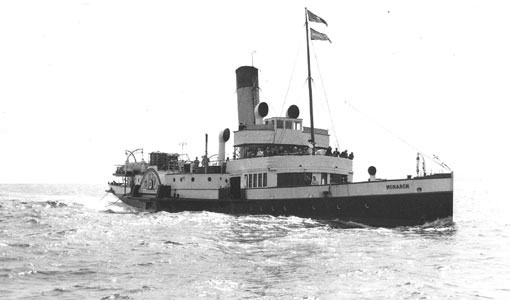
Meanwhile, the operational picture that week was unusually fluid. Bournemouth steamer notice number 5 hedged its bets on how much longer a two‑ship service might continue by stating that it was valid from “Monday August 31st Until Further Notice”. It was anticipated that Monarch might finish her season on Friday 11th September, leaving Embassy to continue alone. But the weather that week was exceptional, and the forecast for the start of the following week also good, so Monarch was kept going for a few more days to milk a bit more revenue out of the Swanage service. Steamer notice number 6 declared its validity from “Monday 14th September Until Further Notice” and showed a two‑ship service up to and including Wednesday 16th September. Steamer notice number 7, issued a couple of days later, was valid from “Thursday September 17th Until Further Notice” and showed just trips on Embassy.
On Wednesday 16th, Monarch was set to finish the Swanage service at Bournemouth at 6pm, at which time she would normally have been advertised for a single trip back to Poole Quay. However, the steamer notice makes no mention of this, so it seems the plan was for her to sail straight back to Weymouth that night without passengers, arriving around 9pm. High water at Weymouth was at 7.43pm, so the tide was falling on her arrival. She might just have got there in sufficient time to pass through the Town Bridge to the lay‑up berth that night; otherwise she was well placed to pass through first thing on Thursday morning with high water at 8.01am. Her master, Captain Haines, then returned to Poole straightaway to take over from Capt Rawle on Embassy.

That same evening, Thursday 15th September, after Embassy had returned to Poole Quay at 8pm, a presentation was made to Captain Rawle by Cosens’ Bournemouth Manager, Commander Johnson, at the Antelope Hotel in Poole. The Bournemouth Echo described the gift as a clock “from members of the crews of the Embassy and Monarch and the Piermasters”. The Dorset Echo added: “Capt Rawle will always have a handsome clock as a permanent reminder of his pleasure steamer days.”
How comfortable a retirement Captain Rawle and his wife enjoyed would have depended on their circumstances and what his pension position actually was.
We know he married in 1925. The couple had one son, Gerald, born in 1929, who would have been 30 when his father retired — already married himself by 1953, with a son of his own, Peter, by 1958.
Capt Rawle spent his final years quietly in the town he had served for so long, latterly living at 252 Dorchester Road — a modest bungalow that hints at a settled and reasonably comfortable later life. He died there in February 1972 aged 78, six years after Cosens sold their last paddle steamer, Embassy — the end of the era to which he had devoted his life. His wife Dorothy Kay “Doll” Rawle outlived him and died in Winchester in July 1979 closing the family’s long connection with Cosens and the Weymouth steamers.
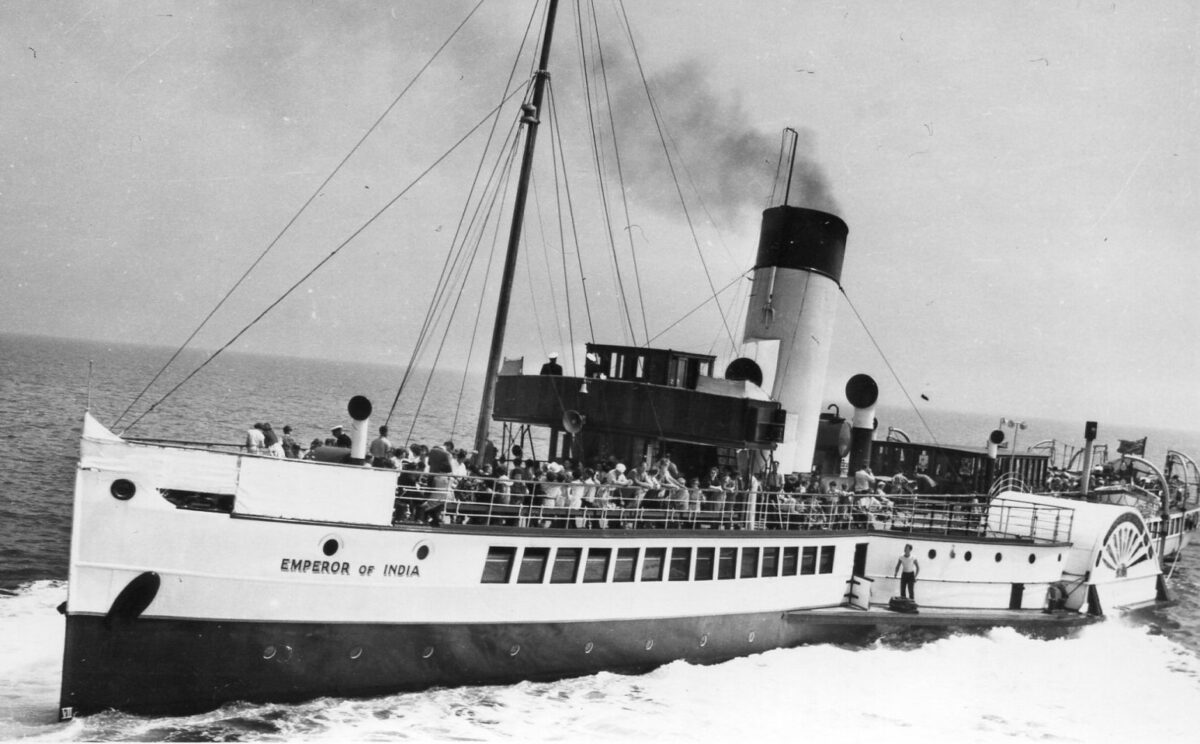
Tiny Point of Detail: A small but telling detail survives from his later life. In an interview for the June 1970 edition of Ships Monthly Capt Rawle reflected candidly on the difficulties of handling Emperor of India: He said “she was a nightmare for all who had to run her. She was built more like a battleship with massive wheels and machinery. Her paddle wheels were deeply immersed and scooped up large quantities of water. At speed or when she listed, as sometimes happened for no apparent reason, her paddle boxes became choked. To try to improve weight issues and make her float higher in the water 18ins was cut off the top of her funnel.”
Kingswear Castle returned to service in 2026 after the second part of a major rebuild which is designed to set her up for the next 25 years. The Paddle Steamer Kingswear Castle Trust is now fund raising for future rebuilds. You can read more and how you can possibly help here.
John Megoran
This article was first published on 13th September 2020.